Laboratory for Dynamics of Machines and Structures
Narrow and third-octave spectra of total flexural vibration and sound power radiation from optical camera measurements
P. Gardonio,
S. Baldini,
D. Gorjup,
J. Slavič and
R. Rinaldo
Mechanical Systems and Signal Processing, Vol. 249, p. 114054, 2026
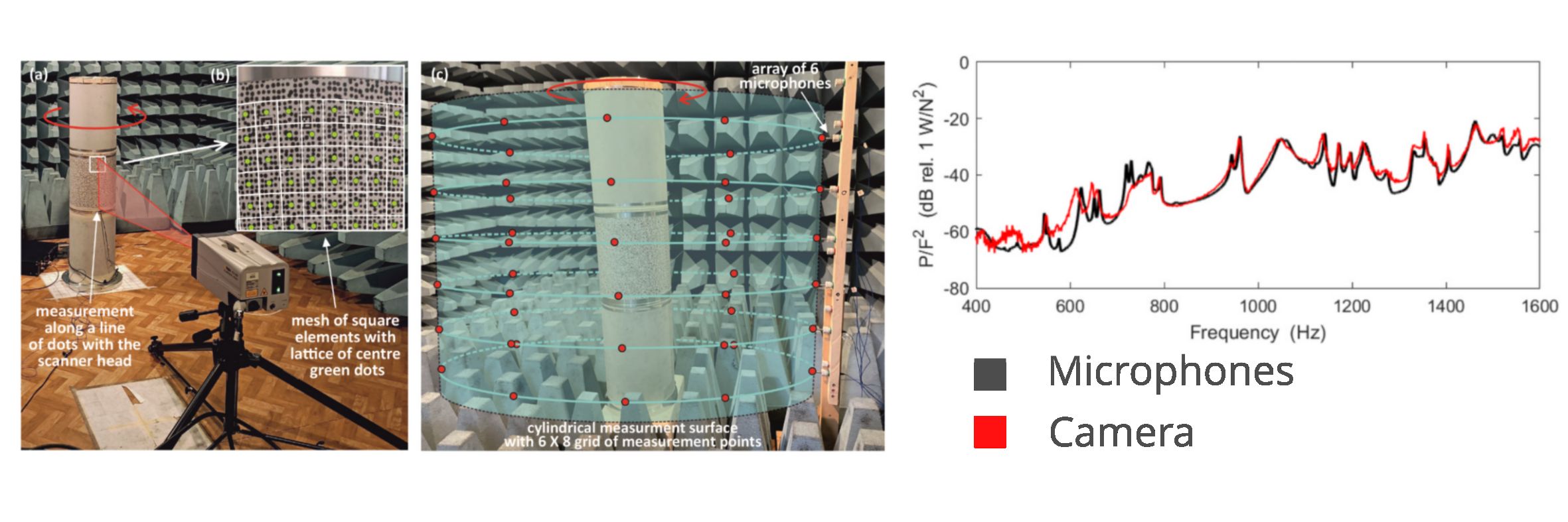
This research presents an optical camera-based method for measuring narrow band and third-octave band spectra of the total flexural vibration and total sound radiation of 2D and 3D structures. The proposed method overcomes key issues inherent in classical vibro-acoustic measurements, such as the requirement of long-duration and full-field measurements and, to some extent, the need of physically masking flanking sources and background noise. Digital image correlation combined with frequency-domain triangulation is employed, which is particularly suited for the derivation of spectral measurements, although classical time-domain triangulation could be employed too. The narrow-band vibration and sound radiation spectra are derived from integral formulations. In particular, the total sound power radiation is derived using the radiation resistance matrix, which can be calculated from numerical quadrature of the boundary integral for the sound radiation. The third-octave band spectra are computed by integration of the narrow band spectra over appropriate frequency-bands. The proposed method is validated for a baffled cylinder model-structure by contrasting the narrow band and third-octave band spectra of the total flexural vibration and total sound power radiation estimated from camera recordings with those obtained from direct measurements taken with a scanning laser vibrometer and a microphones array. The proposed approach offers a valid alternative to traditional vibroacoustic measurements, which does not require expensive laboratory facilities and long lasting and costly measurement campaigns. Furthermore, it can be effectively integrated into laboratory equipment for the offline synthesis and measurement of specific vibroacoustic fields, thus reducing the costs and time of conventional tests on real systems, such as the measurement of a) car tire noise, b) airplane cabin noise caused by the aerodynamic turbulence and the engines, c) room airborne and structure-borne noise produced by household appliances, and d) interior noise transmission through windows and partitions of building.
 download pdf
https://doi.org/10.1016/j.ymssp.2026.114054
download pdf
https://doi.org/10.1016/j.ymssp.2026.114054