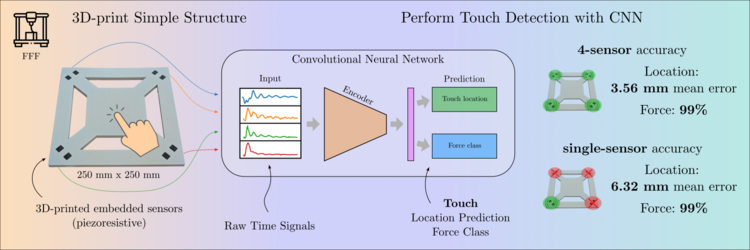
Multi-material 3D-printing enables the single-process embedding of piezoresistive sensors producing multi-functional, fully 3D-printed, smart structures without manual assembly or specialized equipment. However, the low sensitivity and manufacturing variability yield unreliable signals, limiting 3D-printed sensors to simple demonstrations rather than complex sensing tasks. This work introduces a single-process, 3D-printed structure with inherently poor sensing capability that is transformed into a highly accurate smart pad with functional tap localization using a convolutional neural network (CNN). The structure consists of a thermoplastic polyurethane (TPU) pad with up to four embedded piezoresistive sensors fully fabricated through material extrusion (MEX). The CNN processes measured time-series signals to predict the tap location and classify the force magnitude. The 4-sensor smart pad reliably distinguishes individual taps with millimeter accuracy (3.56 mm mean accuracy), enabling touch-pad applications with force classification (>98.7% accuracy). The single-sensor smart pad maintains functional performance (6.32 mm mean accuracy), proving that machine learning compensates for the extreme sensor reduction. This work establishes a rapid-prototyping platform for application-specific CNN-enhanced smart structures in human-machine interfaces, soft robotics, and structural health monitoring.
Link to the code and dataset:
link.
 download pdf
https://doi.org/10.1080/17452759.2026.2640277
download pdf
https://doi.org/10.1080/17452759.2026.2640277